Fakers: Hoaxers, Con Artists, Counterfeiters, and Other Great Pretenders

[Ed. note: Author Paul Maliszewski published an interview with Joey Skaggs in McSweeney’s, Volume #8, August 2002.]


Michael Dirda on “Fakers”
by Michael Dirda
The Washington Post
January 18, 2009

The Madoffs of the world tell us what we want to hear.

fakersFakers: Hoaxers, Con Artists, Counterfeiters, and Other Great Pretenders, By Paul Maliszewski, New Press. 245 pp. $24.95

Paul Maliszewski grew interested in the psychology of faking and forgery when he worked as a young journalist for a small business magazine. Bored, he began to send in letters to the editor under various pseudonyms. These letters, commenting on recent articles, were sly exercises in satire and humor. For example, when the Dow fell in 1997 “Gary Pike” wrote in to describe how he had been “listening” to the Dow, but until one day “I called and called, but the Dow said nothing in return, answering only in silence.” As Maliszewski clearly knows, the Tao of Asian philosophy is pronounced Dow, and in a famous phrase “The Tao is Silent.”

Building on his personal experience with hoaxing, Maliszewski gradually began to publish articles — in the Baffler, McSweeney’s and Bookforum, among other periodicals — about the nature, variety and meaning of modern fakery. Collected here, these pieces cover the phony journalism of Jayson Blair of the New York Times and Stephen Glass of the New Republic; the whole-cloth memoirs of James Frey; the art forgeries of Elmyr de Hory and Han van Meegeren; the provocations of conceptual artists like Sandow Birk (who created a series of “historical” paintings about a supposed war between Northern and Southern California) and Joey Skaggs (who constructed an elaborate website for a nonexistent organization promoting cemeteries designed to resemble theme parks); brief histories of some imaginary poets and their work (the Spectra hoax and the Ern Malley affair); and, finally, novelist Michael Chabon’s “fictional” memoir about his childhood encounter with a Holocaust survivor who turned out to be a Nazi soldier, only who wasn’t since he didn’t really exist. Continue reading “Fakers: Hoaxers, Con Artists, Counterfeiters, and Other Great Pretenders”

What Would Oprah Say?

Anger, sadness over fabricated Holocaust story
By Hillel Italie
1010WINS
December 28, 2008

p52b1ccde-1New York (AP) — It’s the latest story that touched, and betrayed, the world.
“Herman Rosenblat and his wife are the most gentle, loving, beautiful people,” literary agent Andrea Hurst said Sunday, anguishing over why she, and so many others, were taken by Rosenblat’s story of love born on opposite sides of a barbed-wire fence at a concentration camp.

“I question why I never questioned it. I believed it; it was an incredible, hope-filled story.”

On Saturday, Berkley Books canceled Rosenblat’s memoir, “Angel at the Fence,” after he acknowledged that he and his wife did not meet, as they had said for years, at a sub-camp of Buchenwald, where she allegedly sneaked him apples and bread. The book was supposed to come out in February.

Rosenblat, 79, has been married to the former Roma Radzicky for 50 years, since meeting her on a blind date in New York. In a statement issued Saturday through his agent, he described himself as an advocate of love and tolerance who falsified his past to better spread his message. Continue reading “What Would Oprah Say?”

Fake Covers for Fake Books by a Fake Writer. Yes!

Fake Covers for Fake Books by a Fake Writer. Yes!
by Tom Nissley
Omnivoracious.com
(A blog run by the books editors at Amazon.com)
April 20, 2008

eakins_three-425.jpg

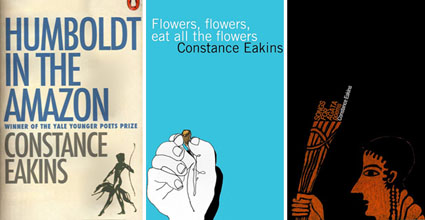
Somebody knows exactly where my buttons are, and is pushing them. As much as I love Paris Review interviews and fake writers, I may have an even softer spot for fake writers, their fake books, and their fake book covers, and Nathaniel Rich’s promotional site for his new novel, The Mayor’s Tongue, having indulged the first, has now granted me the latter, with a full (and growing) gallery of covers of the various fictitious editions of the fictious writer Constance Eakins’s fictitous books, contributed by some sharp designers and illustrators. And it’s not just the idea of it, but the covers themselves, often period pieces that are not only spot-on but gorgeous in their own right. I love, for instance, Zach Dodson’s vintage Penguin pb of Humboldt in the Amazon. But I really adore Joanna Neborsky’s often Brit-feeling covers, of which it was hard to choose just two lovelies to feature above. I think Flowers, Flowers, Eat All the Flowers is my favorite, but I had to include Songs for Agata too because I am certain I bought a copy of that one for $5 in Philadelphia in 1988. It must be on my shelves somewhere…

But my real favorite is Ben Gibson’s full-jacket treatment of The Uncles Ten (below), which I must confess I am fairly desperate to read (I imagine it in the Flann O’Brien vein…). Continue reading “Fake Covers for Fake Books by a Fake Writer. Yes!”

Literary Hoaxes: Irresistible Storytelling

This Column Is Real, But Not All Authors Stick to the Truth
Deja Vu, by Cynthia Crossen
Wall Street Journal
April 7, 2008

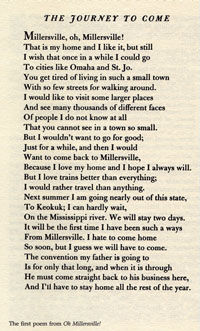
harrison2-200.jpgA popular choice for ladies’ book clubs in the early 1940s was a slim volume of poetry by a 10-year-old girl named Fern Gravel. Fern had written the poems about her Iowa hometown in 1900 and passed them along to someone who had preserved them. In 1940, Fern Gravel decided to publish her nostalgic rhymes under the title, “Oh Millersville!”

Two snippets: “My Sunday-school teacher/Is Miss Minnie King./She is not of any use as a teacher/But I love to hear her sing.” “The soap they use in the Commercial hotel/Is awful; it has a horrible smell./Sometimes we have our Sunday dinner there/And the smell of their soap I can hardly bear.”

Critics were enchanted. The Des Moines Register praised the poems’ “warm feeling of validity.” Time magazine called the author a “precocity in pigtails.” The St. Paul Dispatch said “Oh Millersville!” was marked “for immortality.” And the book became the profit center for its small Iowa publisher, Prairie Press.

Six years later, Fern Gravel confessed: She was really James Norman Hall, co-author of the “Bounty” trilogy. In a 1946 article in the Atlantic Monthly magazine, Mr. Hall described himself as “shame-faced and apologetic,” but claimed that Fern had come to him in a dream and dictated her poems to him.

Literary hoaxes are almost as old as literature. Some have been inspired by poverty, others are simply pranks. Continue reading “Literary Hoaxes: Irresistible Storytelling”

Fictional Memoir: Faux Suffering Strikes Again

A Family Tree of Literary Fakers
by Motoko Rich
New York Times
March 8, 2008

From top, the writers and their books: Margaret Seltzer, last month; Clifford Irving, left, in 1972; Laura Albert leaving federal court in Manhattan in 2007; and James Frey in an interview on "Larry King Live" in 2006.When the news emerged this week that Margaret Seltzer had fabricated her gang memoir, “Love and Consequences,” under the pseudonym Margaret B. Jones, many in the publishing industry and beyond thought: Here we go again.

The most immediate examples that came to mind were, of course, James Frey, the author of the best-selling “Million Little Pieces,” in which he embellished details of his experiences as a drug addict, and J T LeRoy, the novelist thought to be a young West Virginia male prostitute who was actually the fictive alter ego of Laura Albert, a woman now living in San Francisco.

But the history of literary fakers stretches far, far back, at least to the 19th century, when a slave narrative published in 1863 by Archy Moore was revealed as a novel written by a white historian, Richard Hildreth, and into the early 20th, when Joan Lowell wrote a popular autobiography, “Cradle of the Deep,” about her colorful childhood aboard a four-masted ship sailing the South Seas; in fact, she had grown up almost entirely in Berkeley, Calif.

Here follows a lineup of some of the past few decades” most notorious fakes, with proof that in some cases, there are second acts in American lives. Continue reading “Fictional Memoir: Faux Suffering Strikes Again”