Funeral cracks up as dead man screams ‘Let me out!’ of coffin
By Hannah Sparks
New York Post
October 14, 2019
He got the last laugh.
Loved ones at an Irish funeral for Defense Forces veteran Shay Bradley were shocked — then delighted — when they heard the voice of their late friend calling out from his coffin.
“Hello, hello — let me out!,” they heard on Saturday at Bradley’s funeral in Kilmanagh, Leinster, as his casket was lowered into the ground.
The pre-recorded message continued, “Where the f?-?-?k am I? Let me out, let me out. It’s f?-?-?king dark in here. Is that the priest I can hear? This is Shay, I’m in the box. No, in f?-?-?king front of you. I’m dead.”
A video of the posthumous prank, posted to Twitter Sunday, shows mourners laughing and crying as Bradley’s voice began to sing, “Hello again, hello. Hello, I just called to say goodbye.”
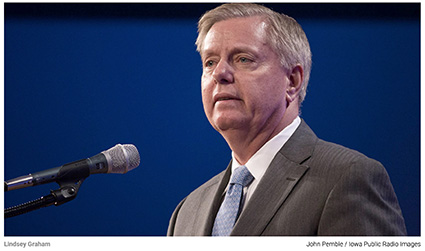
Senator Lindsey Graham was caught by Russian pranksters a few months ago saying the exact opposite of what he just said publicly against Turkey’s aggressions in Syria yesterday. How much more convoluted can our foreign policy get?
Graham thought he was speaking with Turkey’s minister of defense. Instead, it was a pair of Russian pranksters.
Republican Sen. Lindsey Graham has in the last year become something of a congressional point man for President Donald Trump’s negotiations with Turkey, leading discussions on everything from Ankara’s purchase of a Russian missile system over the summer to their more recent incursion into northern Syria.
So when he received a call from a man he thought was Turkey’s minister of defense earlier in August, it didn’t strike him as unusual. “Thank you so much for calling me, Mr. Minister,” Graham said. “I want to make this a win-win, if we can.”
But it wasn’t the Turkish defense minister at all. Instead, it was Alexey Stolyarov and Vladimir Kuznetsov, Russian pranksters with suspected ties to the country’s intelligence services who go by “Lexus and Vovan.” The duo have become notorious in recent years for their cold calls to unwitting, high-profile Western politicians, including Democratic Rep. Adam Schiff, leading some to suspect that they’ve had help from the Kremlin, according to The Guardian. (A Schiff spokesman said at the time that the House Intelligence Committee “informed appropriate law enforcement and security personnel of the conversation.”)
The anonymous artist has opened a shop in the south London borough of Croydon to showcase some of his characteristically humorous items.
photos by Naomi Polonsky
LONDON — Banksy has always had a complicated relationship with the art market. His unsanctioned street works deliberately challenge the idea of art as a tradeable commodity, but often still end up at auction, commanding astronomical prices. A stunt last year during which his “Girl with a Balloon” (2006) self-destructed at a Sotheby’s sale seemed like a rebuke to the art market, but in fact simply doubled the piece’s value.
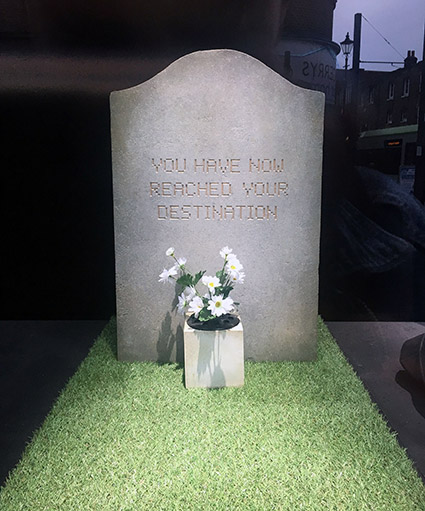
But as of this week, Banksy has officially gone into business. A new installation of his work, unveiled on Tuesday, features a storefront filled with branded merchandise. Although Banksy has exhibited his works in storefront installations before, this is the first time that the items are for sale. All of the products will go on sale online in a couple of weeks with prices starting at £10. Gross Domestic Product, which is located in a disused carpet shop in the south London borough of Croydon, includes old and new works by the artist including the iconic stab vest worn by the grime artist Stormzy at Glastonbury last year…
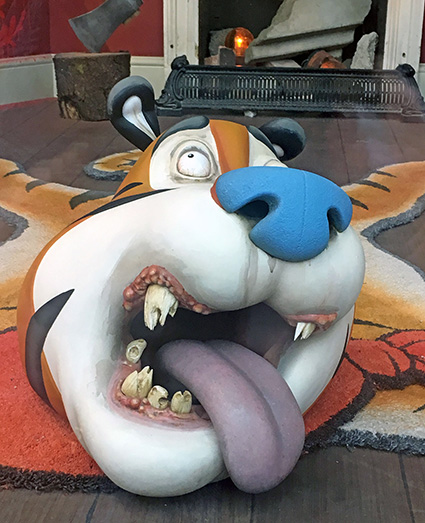
Playing on the double meaning of “gross,” Banksy’s store stocks various disturbing and unsavoury items, such as a rug made from the skin of Tony the Tiger, who has died of diabetes after eating too much Frosted Flakes cereal. A label, written in Banksy’s characteristically irreverent tone, explains that “the floor covering makes quite the conversation piece — especially if the conversation centres around the UK spending over £7.8 million a year on tooth extractions for the under 5s.”
In case you forgot to change the batteries in your calendar, you may not be aware that this year is the 100th anniversary of Citroën. We’ve been shooting a Jason Drives special mini-series for this centenary, and while doing some research I happened to stumble upon a fascinating bit of wartime Citroën lore. It involves screwing with Nazis in a genuinely clever and subtle way that nevertheless had big repercussions. I’ll explain.
So, when France was occupied by the Germans in 1940, major French factories like Citroën were forced to produce equipment for the Nazis. Citroën president Pierre-Jules Boulanger knew he couldn’t just refuse to produce anything, but he also knew there’s no way in hell he’s going to just roll over and build trucks for a bunch of filthy Nazis. Pierre had a plan.
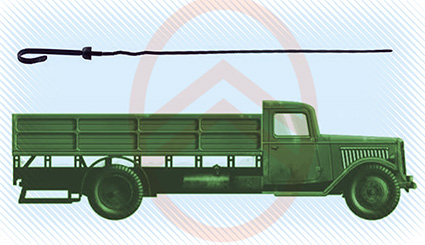
John Reynolds’ book Citroën 2CV describes Boulanger’s sabotage efforts. Of course, he instructed workers to set a nice, leisurely pace when building trucks (likely Citroën T45 trucks) for the Wermacht, but that’s fairly obvious. What was brilliant was Boulanger’s idea to move the little notch on the trucks’ oil dipsticks that indicated the proper level of oil down just a bit lower.
By moving the notch down, the trucks would not have enough oil, but German mechanics would have no idea, because, hey, the little notch on the dipstick says its just fine. Then, after the truck has been used for a while and is out deployed somewhere crucial, whammo, the engine seizes up, and you’ve got a lot of angry, stranded, vulnerable Nazis, balling up their little fists and redly barking curses in German.
It’s such a fantastic act of sabotage: it’s extremely cheap to implement, it’s subtle, there’s no way to see something amiss is happening as the trucks are being built, and it delivers its blow away from the site of the sabotage and when it will cause the most inconvenience and trouble.
I suppose it could be apocryphal, but this is one of those cases where I’m going to choose to believe.
Food: Bigger than the Plate at Victoria and Albert Museum, “examining various approaches to the future of food through contemporary design, art, and engineering”, opened on May 18 in London and is scheduled to run through October 20, 2019.
(right), trying to brie calm, with Thomas Meany, maker of cheeses from humans. COURTESY OF OPEN CELL
ON MAY 18, A TEAM of renegade cheesemakers will showcase some very outré cheese at the Victoria and Albert Museum’s forthcoming exhibition, Food: Bigger than the Plate. No samplings of this cheese, which will be showcased in climate-controlled glass, shall be on offer. Which is just as well, since they have been made with bacteria from the bodies of British celebrities.
Alex James of the rock band Blur, Michelin-star chef Heston Blumenthal, former Great British Bake Off finalist and author Ruby Tandoh, the singer-songwriter Suggs, and the rapper Professor Green all volunteered their bodily bacteria for science. More specifically, a chef, a synthetic biologist, and a biodesigner turned their body swabs into starter culture for the five cheeses that make up the exhibit, named Selfmade.
Helene Steiner and Thomas Meany are the team behind Open Cell, a biotechnology research hub housed within 45 shipping containers in Shepherd’s Bush, London. Together with chef John Quilter, who goes by Food Busker, the human-cheese artisans have been maturing a cheshire cheese (from Alex James), a comté (Heston Blumenthal), a mozzarella (Professor Green), a Stilton (Ruby Tandoh), and a Cheddar (Suggs). All five cheeses are maturing at the Open Cell lab, and will continue to age at the V&A’s Food exhibition, one of 70 exhibits examining various approaches to the future of food through contemporary design, art, and engineering.
The Selfmade team has launched a Youtube series to promote and explain the project, whose first episode aired on May 11, on Food Busker’s channel. In it, Professor Green gamely declares, “I hate cheese, but I’m here to be made into one.”