Google Maps, the Fraud Frontier

It’s the wild, wild west. Why has Google Maps, “plagued by fake reviews, ghost listings, lead generation schemes and impersonators,” barely begun to fight back?


These online volunteers fight fake reviews, ghost listings and other scams on Google Maps — and say the problem’s getting worse
by Jillian D’Onfro
CNBC
April 13, 2018

Tom Waddington was hanging out at a friend’s house when he got an unexpected notification from Google Maps.

Waddington is part of a group of Google Maps advocates who are trying to improve the service, so he lets Google track his location and frequently adds photos or edits to Maps listings.

So the notification itself was routine, but the message was strange: Maps wanted him to contribute information about the Urgent Care center nearby. He was in a residential neighborhood.

He opened the app and, sure enough, one of the houses next door was listed as a clinic. A telemedicine company that also made house calls had falsely claimed that physical address to try to increase business. The scammers hoped potential patients would search Maps for Urgent Care centers nearby, then call its number to schedule a house call or virtual appointment.

These growth-hacking scams can have consequences: Waddington found someone who claimed to have taken his child to one of these non-existent clinics. Read the rest here.

Behold Instagram’s Digital Conmen

Money, money, money… money.

“Oyefeso is one of the most high-profile figures of an internet subculture that reveres Jordan Belfort and has taken his Wolf of Wall Street persona to social media. Posing as ultra-wealthy kids and posting internet memes taken from the movie, its followers aggressively sign up young people to what looks like an international pyramid scheme that has helped to generate billions of pounds for large companies selling highly risky financial trading products.” -Symeon Brown


Fake it till you make it: meet the wolves of Instagram
by Symeon Brown
The Guardian
April 19, 2018

Their hero is Jordan Belfort, their social media feeds display super-rich lifestyles. But what are these self-styled traders really selling?

The original Wolf of Wall Street, Jordan Belfort, was a rogue trader convicted of fraudulently selling worthless penny stocks to naive investors. His biopic, starring Leonardo DiCaprio as the ostentatious, money-obsessed huckster, was a box-office hit in 2013. Although it may have been intended as a cautionary tale, to thousands of young millennials from humble backgrounds, Belfort’s story became a blueprint for how to escape an unremarkable life on low pay.

Within months of the Wolf of Wall Street’s UK premiere in January 2014, a stocky 21-year-old named Elijah Oyefeso from a south London housing estate, began broadcasting on social media how much money he was making as a stock-market whizzkid. His thousands of young followers were desperate to do the same. As Oyefeso’s online fame grew, he caught the attention of TV producers. In January 2016, Oyefeso was featured in the Channel 4 show Rich Kids Go Shopping, in which he bought expensive jumpers to give to homeless people and showed viewers how easy it was to make stock trades online.

Even before Oyefeso’s appearance on mainstream TV, his story had already gone viral. British tabloids, including the Daily Mail, the Evening Standard and the Mirror, as well as a host of online magazines targeted at young men, all ran pieces about his success. The Mail headline described him as a university dropout who supposedly used his student loan to start trading financial products online and “now claims he earns £30,000 on a BAD month – by working just ONE HOUR a day”.

It’s an image of self-made wealth and ridiculous luxury, and one that Oyefeso has intensively cultivated online. The videos on his almost comedic YouTube channel, which have hundreds of thousands of views, feature him buying £250,000 cars and boarding private jets as nonchalantly as others his age might hail an Uber. His Instagram, which regularly shows him posing next to a blue and silver Rolls-Royce, describes him as the founder of DCT, his trading firm. DCT stands for “Dreams Come True”.

“I’m never going to work for someone,” Oyefeso says in one of his videos, in a somewhat cartoonish, nasal voice, while he drives his Rolls dressed in a bathrobe. “Look what I’ve built: a foundation. A brand.” Read more

Sinclair Broadcasting Screams “Fake News” But They Are Fake News!

Gene Policinski, President & COO of the Newseum Institute, opines on the Sinclair Publishing hostage scenario revealed by Deadspin in a video of news anchors all over the country spouting chillingly identical propaganda.


Policinski: Next time, just put your name to the message
Gene Policinski
Indise the First Amendment
April 7, 2018

Sinclair Broadcasting’s recent promotional message on the state of today’s news — delivered to its TV audiences nationwide — is as protected by the First Amendment as it was an oafish attempt to hide corporate messaging under the veneer of local news reporting.

In other words, it was commentary from a conservative company that has a First Amendment right to express its views, but it was also a shoddy tactic that undermined the very thing Sinclair’s leadership claimed to support: good journalism.

Deadspin — an online sports news site — put together a now widely shared video of news anchors from 45 Sinclair-owned American stations, all reading in synchrony from the same script. The video’s echo-chamber effect laid bare what many have described as an “Orwellian” attempt to deliver a persuasive message using trusted voices in local journalism.

Watch the video:
Sinclair’s Soldiers in Trump’s War on Media Video, by Deadspin

The mash-up of TV anchors, delivering the script with varying degrees of sincerity, prompted dire warnings from left-leaning cable news commentators about media consolidation and ulterior political motives.

President Trump tweeted a defense of Sinclair, using the controversy to take yet another swipe at the same mainstream news outlets he frequently attacks: “So funny to watch Fake News Networks, among the most dishonest groups of people I have ever dealt with, criticize Sinclair Broadcasting for being biased.”

Trump has it wrong — critics took aim at the method, not the message.

Let’s parse the actual effort… Read the rest of this article here.

Aviv Ovadya and the Coming “Infocalypse”

In a far-ranging, frightening, and fascinating interview, Buzzfeed News catches up with engineer and tech prognosticator Aviv Ovadya, who anticipated the current scourge of “fake news” and says we haven’t seen anything yet.


“He Predicted The 2016 Fake News Crisis. Now He’s Worried About An Information Apocalypse.”
By Charlie Warzel
Buzzfeed
February 11, 2018

In mid-2016, Aviv Ovadya realized there was something fundamentally wrong with the internet — so wrong that he abandoned his work and sounded an alarm. A few weeks before the 2016 election, he presented his concerns to technologists in San Francisco’s Bay Area and warned of an impending crisis of misinformation in a presentation he titled “Infocalypse”

The web and the information ecosystem that had developed around it was wildly unhealthy, Ovadya argued. The incentives that governed its biggest platforms were calibrated to reward information that was often misleading and polarizing, or both. Platforms like Facebook, Twitter, and Google prioritized clicks, shares, ads, and money over quality of information, and Ovadya couldn’t shake the feeling that it was all building toward something bad — a kind of critical threshold of addictive and toxic misinformation. The presentation was largely ignored by employees from the Big Tech platforms — including a few from Facebook who would later go on to drive the company’s NewsFeed integrity effort.

“At the time, it felt like we were in a car careening out of control and it wasn’t just that everyone was saying, “we’ll be fine’ — it’s that they didn’t even see the car,” he said.

Ovadya saw early what many — including lawmakers, journalists, and Big Tech CEOs — wouldn’t grasp until months later: Our platformed and algorithmically optimized world is vulnerable — to propaganda, to misinformation, to dark targeted advertising from foreign governments — so much so that it threatens to undermine a cornerstone of human discourse: the credibility of fact.

But it’s what he sees coming next that will really scare the shit out of you. Read more.

Disinformation at the Speed of Light

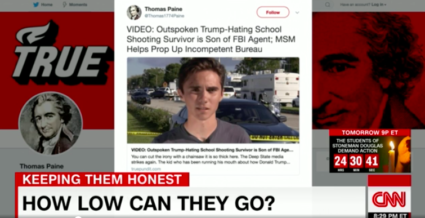
At a time of unspeakable tragedy, Russian propagandists and right wing conspiracy theorists work together to neutralize a rational, well-spoken high school student pleading for safe schools.


How the Florida school shooting conspiracies sprouted and spread
by Paul P. Murphy and Gianluca Mezzofiore
CNN
February 22, 2018

(CNN)Conspiracy theories after mass shootings follow a familiar thread and the Florida school shooting is no exception.

They originate in the dark corners of the internet — often from the 4chan “politically incorrect” board (abbreviated as /pol/) — and migrate onto social media platforms like Twitter, YouTube and Facebook from conservative pages, alt-right personalities, nationalist blogs and far-right pundits.

What drives hoaxes and conspiracy theorists is unclear. But their faith in the conspiracies they spread seems to be unwavering.

Less than an hour after the shooting at Marjory Stoneman Douglas High School in Parkland on February 14, Twitter accounts were claiming that eyewitnesses were “crisis actors.” The term refers to people who are paid to play disaster victims in emergency drills. More recently, though, the phrase has been co-opted by conspiracy theorists who claim mass shootings are events staged to achieve a political goal.

A CNN investigation into 4chan’s /pol/ archive counted at least 121 times that school shooting survivor David Hogg was mentioned on the board. Read the rest of this article here.