Disinformation at the Speed of Light

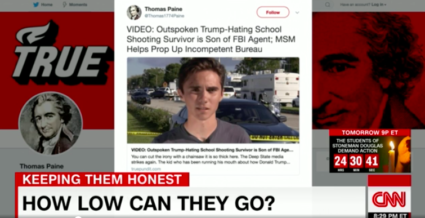
At a time of unspeakable tragedy, Russian propagandists and right wing conspiracy theorists work together to neutralize a rational, well-spoken high school student pleading for safe schools.


How the Florida school shooting conspiracies sprouted and spread
by Paul P. Murphy and Gianluca Mezzofiore
CNN
February 22, 2018

(CNN)Conspiracy theories after mass shootings follow a familiar thread and the Florida school shooting is no exception.

They originate in the dark corners of the internet — often from the 4chan “politically incorrect” board (abbreviated as /pol/) — and migrate onto social media platforms like Twitter, YouTube and Facebook from conservative pages, alt-right personalities, nationalist blogs and far-right pundits.

What drives hoaxes and conspiracy theorists is unclear. But their faith in the conspiracies they spread seems to be unwavering.

Less than an hour after the shooting at Marjory Stoneman Douglas High School in Parkland on February 14, Twitter accounts were claiming that eyewitnesses were “crisis actors.” The term refers to people who are paid to play disaster victims in emergency drills. More recently, though, the phrase has been co-opted by conspiracy theorists who claim mass shootings are events staged to achieve a political goal.

A CNN investigation into 4chan’s /pol/ archive counted at least 121 times that school shooting survivor David Hogg was mentioned on the board. Read the rest of this article here.

Deepfake: AI-Assisted Porn

Hey! What’s my face doing on a porn star’s body?


Everything You Need To Know About The Face-Swap Technology That’s Sweeping The Internet (And Getting Banned Everywhere)
Digg
February 8, 2018

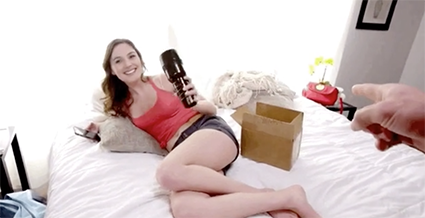
Gal Gadot’s face on someone else’s body. Image: Screenshot from SendVids

In the past couple of months, “deepfake” has gone from a nonsense word to a widely-used synonym for videos in which one person’s face is digitally grafted onto another person’s body. The most popular “” and troubling “” type of deepfake is artificially produced porn appearing to star famous actresses like Gal Gadot, Daisy Ridley and Scarlett Johansson. Sites like Reddit and Pornhub have made moves to ban pornographic deepfakes in recent days, but it’s never been easier for anyone with an internet connection to make disturbingly real-looking porn by mapping almost anyone’s face over those of porn performers. Here’s what you need to know.

‘Deepfake’ Celebrity Porn First Emerged In December

In an only somewhat hyperbolically titled article called “AI-Assisted Fake Porn Is Here and We’re All Fucked,” Motherboard’s Samantha Cole interviewed the first Redditor to post convincing face-swapped videos, who called himself “deepfakes.” (“Deepfake” which has since become a term used the doctored videos produced by the technology.) “Deepfakes” explained how he created a porn video appearing to star Gal Gadot. Read the rest here.

Forget About Getting a Table Here

Update January 25, 2018: Vice Video: How to Become TripAdvisor’s #1 Fake Restaurant. Thanks Frank.

The London restaurant so exclusive that no one could ever get a reservation. H/t Bob O’Keefe.

Bonus: Oobah Butler’s Vice play book on how he pulled it off.


“The Shed at Dulwich” was London’s top-rated restaurant. Just one problem: It didn’t exist.
By Eli Rosenberg
The Washington Post
December 8, 2017

It was a unique restaurant in London and certainly the hardest to get into. And it beat out thousands of upscale restaurants in the city to earn the top ranking on the popular review site TripAdvisor for a time, drawing a flood of interest.

There was just one small problem: It didn’t exist.

The restaurant was just a listing created this year by a freelance writer, Oobah Butler, who used his home — a shed in the Dulwich area in South London — as the inspiration for a high-concept new restaurant that he posted on TripAdvisor: “The Shed at Dulwich.”

With hardly more than some fake reviews — “Best shed based experience in London!” a particularly cheeky one read — and a website, it had gamed the site’s ratings in London, a highly sought after designation that could bring a surge of business to any restaurant, let alone one in major global capital.

The story has by now traveled around the globe and back, after Butler wrote a piece that exposed the ruse on Vice. It has been hailed as an incredible feat. But in an era increasingly influenced by disinformation online, it also has served as another reminder of the ease with which pranksters and other dishonest actors are able to manipulate online platforms to sometimes unthinkable results. Read more.

New Dirty Politics: Fake Internet Comments

Fake internet comments may be the only thing worse than real internet comments.


“Fake Comments on Trump Administration Website are Trying to Take Down an Obama-era Rule”
By Greg Price
Newsweek
December 27, 2018

Critical fake comments, attributed to a real person, were reportedly posted against a controversial fiduciary rule to the Department of Labor”s website, presumably to convince the department to do away with the rule altogether.

Altogether, 40 percent of people who responded to a survey conducted for The Wall Street Journal stated they did not write the negative comments against the rule first implemented under former President Barack Obama to protect investors and avoid conflicts of interest at brokerage firms and other financial institutions.

The survey was conducted by research firm Mercury Analytics for The Journal. It was sent to 345 people out of the 3,100 comments posted to the Labor Department”s site about the fiduciary rule. Most of the 345 comments were critical of the rule, but of the 50 people to respond to the survey, 20 told The Journal they did not author the critical post.

Tracing the Roots of Wishful Thinking

As the year-end recaps gather on the horizon, many will attempt to make sense of Donald Trump’s ascent to the Presidency. Kurt Andersen’s book Fantasyland: How America Went Haywire provides a fascinating road-map.

The Atlantic posted a long excerpt. This is from Delancey Place about the roots of our inbred susceptibility to advertising.


“Are Americans More Willing to Believe in Advertising?”
Delancey Place
December 4, 2017

From the earliest days, and continuing for decades and even centuries, promoters of the New World enticed colonizers with the promise of riches, causing the historian Daniel Boorstin to suggest that ‘American civilization [has] been shaped by the fact that there was a kind of natural selection here of those people who were willing to believe in advertising’:

“Although [Sir Walter] Raleigh never visited North America himself, he believed that in addition to its gold deposits, his realm might somehow be the biblical Garden of Eden. … A large fraction of the first settlers dispatched by Raleigh became sick and died. He dispatched a second expedi­tion of gold-hunters. It also failed, and all those colonists died. But Sir Walter continued believing the dream of gold.

“In 1606 the new English king, James, despite Raleigh’s colonization di­sasters, gave a franchise to two new private enterprises, the Virginia Com­pany of London and the Virginia Company of Plymouth, to start colonies. The southern one, under the auspices of London, they named Jamestown after the monarch. Their royal charter was clear about the main mission: ‘to dig, mine, and search for all Manner of Mines of Gold … And to HAVE and enjoy the Gold.’ As Tocqueville wrote in his history two centuries later, ‘It was … gold-seekers who were sent to Virginia. No noble thought or conception above gain presided over the foundation of the new settlements.’ Two­-thirds of those first hundred gold-seekers promptly died. But the captain of the expedition returned to England claiming to have found ‘gold showing mountains.’ … In fact, Jamestown ore they dug and refined and shipped to England turned out to be iron pyrite, fool’s gold….” Read more.