ADHD Investing

Top 2009 Resolution: Don’t Be Stupid
by Daniel Henninger
Wall Street Journal
January 8, 2008

Bernard Madoff revealed our thoughtless ways.
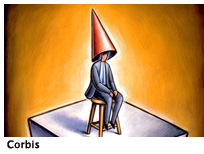
adhd-investingBack in olden times, mankind found it useful to live by mottoes. A motto reduces the helpful lessons of life to three or four words, maybe two, as in the Boy Scout motto: Be Prepared. Or, apropos now: Look before you leap.

The most famous motto in our time has been Google’s Don’t Be Evil. I’m not sure what that means exactly, but here’s a motto for the next four or five years: Don’t Be Stupid.

It would not have occurred to me to posit Don’t Be Stupid as a motto for our times had not 2008 ended with the Bernard Madoff story. Up to then, we were all preoccupied with the economic meltdown that began in mid-September with the collapse of Lehman Brothers and other household gods of global finance.

The economic crisis, originating in the subprime mortgage lending phenomenon, was said to be complex. Madoff’s story, however, was simple. For years, uncounted numbers of the most sophisticated people here and in Europe conveyed to Mr. Madoff tens of billions of dollars because this solitary investor, unlike virtually every other professional investor, achieved returns in excess of 10% annually in all economic seasons. Continue reading “ADHD Investing”
The Gullibility Factor

Why We Keep Falling for Financial Scams
by Stephen Greenspan
The Wall Street Journal
January 3, 2009

Intelligent people have long been ruined by frauds. Psychologist Stephen Greenspan, who specializes in gullibility, explores why investors continue to be swindled — and how he came to lose part of his savings to Bernard Madoff.

anatomyofgullibility

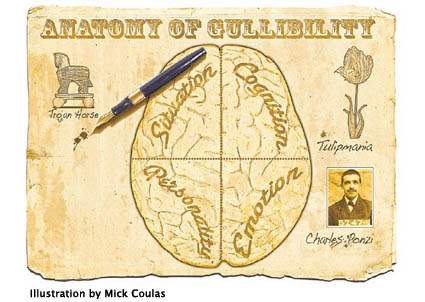
There are few areas where skepticism is more important than how one invests one’s life savings. Yet intelligent and educated people, some of them naà¯ve about finance and others quite knowledgeable, have been ruined by schemes that turned out to be highly dubious and quite often fraudulent. The most dramatic example of this in American history is the recent announcement that Bernard Madoff, a highly regarded money manager and a former chairman of Nasdaq, has for years been running a very sophisticated Ponzi scheme, which by his own admission has defrauded wealthy investors, charities and other funds of at least $50 billion. Continue reading “The Gullibility Factor”

Pranks Psych 101

Submitted by Steffani Martin and Peter Maloney:

April Fool! The Purpose of Pranks
by Benedict Carey
New York Times
April 1, 2008

01mind3952-3.jpgKeep it above the belt, stop short of total humiliation and, if possible, mix in some irony, some drama, maybe even a bogus call from the person”s old flame or new boss. A good prank, of course, involves good stagecraft. But it also requires emotional intuition.

Psychologists have studied pranks for years, often in the context of harassment, bullying and all manner of malicious exclusion and prejudice.

Yet practical jokes are far more commonly an effort to bring a person into a group, anthropologists have found “” an integral part of rituals around the world intended to temper success with humility. And recent research suggests that the experience of being duped can stir self-reflection in a way few other experiences can, functioning as a check on arrogance or obliviousness. Continue reading “Pranks Psych 101”

Why’d ya do it?

U-Turn, by Bruce BriersonAn interesting perspective on why some people think about taking a leap and other people actually do it…


Brian Lynch reviews U-Turn: What If You Woke Up One Morning and Realized You Were Living the Wrong Life? by Bruce Grierson, for www.straight.com.

Pranks Defined

books_cov_prank.jpg

This definition of pranks is from V.Vale’s introduction to his formative book PRANKS, published in 1987 by RE/Search Publications. I’ve always loved this essay. He has graciously allowed us to reprint it here. In 2006, RE/Search Publications released a follow-up book called Pranks! 2 that is equally seminal in its approach to the subject -JS


PRANKS. According to the Merriam-Webster New Collegiate Dictionary, a prank is a “trick . . . a mildly mischievous act . . . a practical joke . . . a ludicrous act.” The best pranks invoke the imagination, poetic imagery, the unexpected and a deep level of irony or social criticism””such as Boyd Rice’s presentation of a skinned sheep’s head on a silver platter to Betty Ford, First Lady of the United States. Great pranks create synaesthetic experiences which are unmistakably exciting, original, and reverberating, as well as creative, metaphoric, poetic and artistic. If these criteria be deemed sufficient, then pranks can be considered as constituting an art form and genre in themselves.

However slighted by Academia, pranks are not without cultural and historical precedent. Continue reading “Pranks Defined”