Alfred Jarry, the father of ‘pataphysics

From Wikipedia, the free encyclopedia:


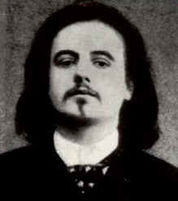
Alfred jarryAlfred Jarry (September 8, 1873 – November 1, 1907) was a French writer born in Laval, Mayenne, France, not far from the border of Brittany; he was of Breton descent on his mother’s side.

Best known for his play Ubu Roi (1896), which is often cited as a forerunner to the theatre of the absurd, Jarry wrote in a variety of genres and styles. He wrote plays, novels, poetry, essays and speculative journalism. His texts present some pioneering work in the field of absurdist literature. Sometimes grotesque or misunderstood (i.e. the opening line in his play Ubu Roi, “Merdre!”, has been translated into English as “Shittr!”, “Shikt!”, and “Pschitt!”), he invented a science called ‘pataphysics.

Biography and works

A precociously brilliant student, Jarry enthralled his classmates with a gift for pranks and troublemaking.

At the lycée in Rennes when he was 15, he led of a group of boys who devoted much time and energy to poking fun at their well-meaning, obese and incompetent physics teacher, a man named Hébert. Jarry and classmate Charles Morin wrote a play they called Les Polonais and performed it with marionettes in the home of one of their friends. The main character, Père Heb, was a blunderer with a huge belly; three teeth (one of stone, one of iron, and one of wood); a single, retractable ear; and a misshapen body. In Jarry’s later work Ubu Roi, Père Heb would develop into Ubu, one of the most monstrous and astonishing characters in French literature.

Read more about Alfred Jarry at Wikipedia…

“Pataphysics, the science of imaginary solutions

From Wikipedia, the free encyclopedia:


‘Pataphysics, a term coined by the French writer Alfred Jarry, is a philosophy dedicated to studying what lies beyond the realm of metaphysics. It is a parody of the theory and methods of modern science and is often expressed in nonsensical language. A practitioner of ‘pataphysics is a ‘pataphysician or a ‘pataphysicist.

The term first appeared in print in Alfred Jarry’s play text “Guignol” in the 28 April 1893 issue of L’à‰cho de Paris littéraire illustré. Jarry later defined it as “the science of imaginary solutions, which symbolically attributes the properties of objects, described by their virtuality, to their lineaments” (Gestes et opinions du Docteur Faustroll, II, viii). Raymond Queneau has described ‘pataphysics as resting “on the truth of contradictions and exceptions.”

Jarry mandated the inclusion of the apostrophe in the orthography “to avoid a simple pun,” the pun possibly being patte à physique (leg of physics), as interpreted by Jarry scholars Keith Beaumont and Roger Shattuck, or possibly pas ta physique (not your physics), or maybe “Pâte à physique” (physics dough).

Read more about ‘Pataphysics at Wikipedia…

The Art of the Con: A notorious prankster uses hoaxes to expose the media

Joseph Gregor (aka Joey Skaggs) in Metamorphosis

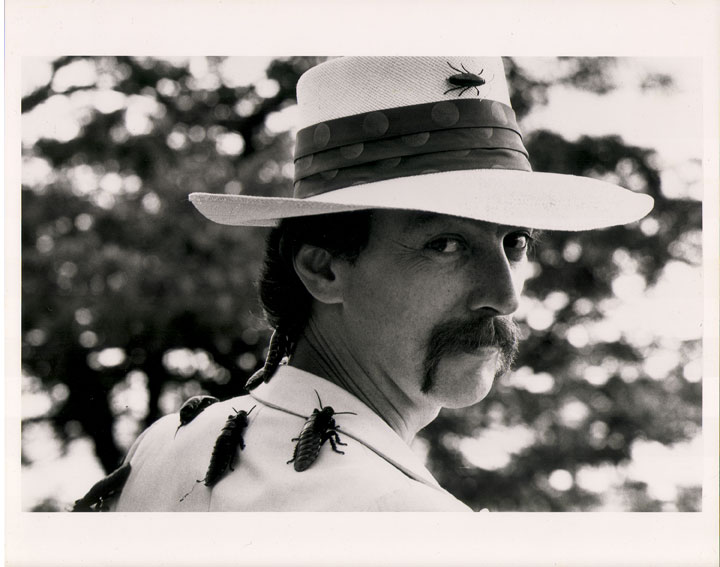
This article was published in Extra! by FAIR (Fairness & Accuracy in Reporting) in the 1999 March/April issue. Although I’ve produced many new works since then, the basic premises described below still resonate for me. This should provide a pretty good summary of the intent of my work and why I do it. I hope it also sets a positive and creative tone for this Blog. -JS


We’re living in a time when it seems everything we see on the news is a bad joke: President Clinton and impeachment, Y2K and the end of the world, Viagra raising the dead, cloning your dead pet dog.

So how can a conscientious media prankster make a mark? When reality gets this strange, pranks are needed more than ever to jolt us into reexamining our values.

With the Internet’s immediacy, its availability to anyone wishing to plant an idea, service or product for the world to consume, there’s more opportunity than ever for both pranks and scams. Anyone can send an e-mail, create a rumor on Usenet, make a website and look official with very little effort or cost.

To me the prank is fine art. Continue reading “The Art of the Con: A notorious prankster uses hoaxes to expose the media”

Pranks Defined

books_cov_prank.jpg

This definition of pranks is from V.Vale’s introduction to his formative book PRANKS, published in 1987 by RE/Search Publications. I’ve always loved this essay. He has graciously allowed us to reprint it here. In 2006, RE/Search Publications released a follow-up book called Pranks! 2 that is equally seminal in its approach to the subject -JS


PRANKS. According to the Merriam-Webster New Collegiate Dictionary, a prank is a “trick . . . a mildly mischievous act . . . a practical joke . . . a ludicrous act.” The best pranks invoke the imagination, poetic imagery, the unexpected and a deep level of irony or social criticism””such as Boyd Rice’s presentation of a skinned sheep’s head on a silver platter to Betty Ford, First Lady of the United States. Great pranks create synaesthetic experiences which are unmistakably exciting, original, and reverberating, as well as creative, metaphoric, poetic and artistic. If these criteria be deemed sufficient, then pranks can be considered as constituting an art form and genre in themselves.

However slighted by Academia, pranks are not without cultural and historical precedent. Continue reading “Pranks Defined”