Television Doc about Artist (and Prankster) Chuck Connelly

From the HBO Website:

by Chuck Connelly

The Art of Failure: Chuck Connelly Not for Sale is the unusual story of the rise and fall of a major talent, along with Julian Schnabel and Jean-Michel Basquiat, from the 1980s art world. Though he was extremely talented with a profitable collection of work, Chuck Connelly ended up alienating every collector and gallery owner he worked with. This 63-minute documentary (currently airing on HBO) follows the life of this brilliant yet enigmatic painter, who had great success as a young artist but who now sees his career fading.

Driven by desperation, and left by his wife during the course of this documentary, Connelly hires an actor to pose as a young, upcoming artist to sell Chuck’s work to galleries and art dealers.

For more information, check out:

  • ChuckConnelly.com
  • The Art of Failure Web site
  • Variety Review of the documentary
  • Continue reading “Television Doc about Artist (and Prankster) Chuck Connelly”

    Hollywood’s Sign of the Time

    Forever Hollywood
    by Kevin Ferguson
    LA City Beat
    June 2008

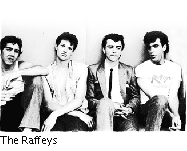
    The RaffeysThe Hollywood sign was our Everest once – artists and men of vision hoofed it up Mount Lee and (depending on one”s receptivity to change and general placement on the deference to authority scale) defaced it, vandalized it, or created monumental public art from it … because it was there. Before the locked gates, the motion sensors, and the security cameras, you could turn Los Angeles”s most famous landmark – “our Eiffel Tower” according to Tom LaBonge – into any screed, any message, as long as it was nine letters or less. From 1976 to 1996, a small and diverse group of people did exactly that to our most famous landmark – the one that marked our land, in fact, as a city of the world: In those 20 years our Hollywood sign was edited at least 13 times.

    Rarely was the message a proper jeremiad. Rarely would it change the lives of those who beheld it. Rarely did it instruct us how to live, or offer the answers to life, the universe and everything. (Forty-two.) Most of the time, in fact, it was utterly banal – rock bands or frat boys seeking some pub.

    A few times (due mostly to the efforts of one artist), the sign made the leap to beautiful pith, more distilled and concise than the sparest haiku, the most soulful wit. But even the rest of the time, when it was just some joes looking for promotion, a maneuver on that scale must be considered art too. Continue reading “Hollywood’s Sign of the Time”

    Artist Robert Rauschenberg Dead at 82

    Robert Rauschenberg, American Artist, Dies at 82
    by Michael Kimmelman
    The New York Times
    May 14, 2008
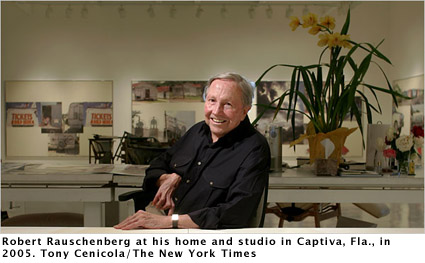
    Robert Rauschenberg, Tony Cenicola/The New York Times

    Robert Rauschenberg, the irrepressibly prolific American artist who time and again reshaped art in the 20th century, died on Monday night at his home on Captiva Island, Fla. He was 82.

    The cause was heart failure, said Arne Glimcher, chairman of PaceWildenstein, the Manhattan gallery that represents Mr. Rauschenberg.

    Mr. Rauschenberg”s work gave new meaning to sculpture. “Canyon,” for instance, consisted of a stuffed bald eagle attached to a canvas. “Monogram” was a stuffed goat girdled by a tire atop a painted panel. “Bed” entailed a quilt, sheet and pillow, slathered with paint, as if soaked in blood, framed on the wall. All became icons of postwar modernism.
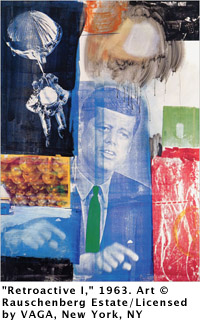
    Robert Rauschenberg, "Retroactive I," 1963A painter, photographer, printmaker, choreographer, onstage performer, set designer and, in later years, even a composer, Mr. Rauschenberg defied the traditional idea that an artist stick to one medium or style. He pushed, prodded and sometimes reconceived all the mediums in which he worked.

    Building on the legacies of Marcel Duchamp, Kurt Schwitters, Joseph Cornell and others, he helped obscure the lines between painting and sculpture, painting and photography, photography and printmaking, sculpture and photography, sculpture and dance, sculpture and technology, technology and performance art “” not to mention between art and life.

    Mr. Rauschenberg was also instrumental in pushing American art onward from Abstract Expressionism, the dominant movement when he emerged, during the early 1950s. He became a transformative link between artists like Jackson Pollock and Willem de Kooning and those who came next, artists identified with Pop, Conceptualism, Happenings, Process Art and other new kinds of art in which he played a signal role. Continue reading “Artist Robert Rauschenberg Dead at 82”
    Pranks as Tools for Propaganda

    From New Right Australia / New Zealand Web site:

    The New Right is organised throughout Europe and beyond. We are strongly opposed to liberalism, democracy and egalitarianism and fight to restore the eternal values and principles that have become submerged beneath the corrosive tsunami of the modern world. The New Right has an interest in the various strands of thought connected with the Traditionalists, the Revolutionary Conservatives; the Nouvelle Droit; and the Eurasianists.


    fatbastarddiscovershisblogi-200.jpgHumour as a Weapon
    by Andreas Gaust
    New Right Australia / New Zealand
    May 8, 2008

    This article has been researched and compiled for the purposes of educating New Right and N-A activists in the use of humour as a political weapon. There is a paranoid feeling amongst many on the New Right that the mass media is our greatest enemy. Not so. This article looks at the ways in which activists can use and manipulate the media, rather than the other way around.

    As an example: mention the 1932 opening of the Sydney Harbour Bridge to any older Australian, and the first image that will spring to their mind is a man on horseback, galloping forward to slash the ribbon with his sword, before the “˜official” representative could get to it. The swordsman was a member of a political group called the New Guard. And while this stunt was not especially humorous, it was certainly eye-catching – it remains in the mass mind to this day. In that same city in 2007, the crew of television show The Chaser made world headlines when they infiltrated the APEC forum (one of them dressed as Osama bin Laden), making a complete mockery of the forum”s expensive security measures.

    In general, the media doesn”t give coverage to alternative politics (the recent 9/11 Truth Forum in Sydney was completely ignored, even though one of the speakers was a prominent Japanese MP). But “˜fringe” views can get past the editors if they are presented by means of some humorous prank or stunt. Continue reading “Pranks as Tools for Propaganda”

    Literary Hoaxes: Irresistible Storytelling

    This Column Is Real, But Not All Authors Stick to the Truth
    Deja Vu, by Cynthia Crossen
    Wall Street Journal
    April 7, 2008

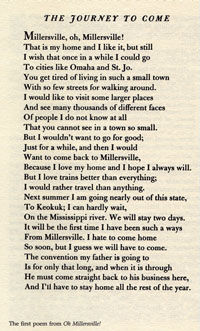
    harrison2-200.jpgA popular choice for ladies’ book clubs in the early 1940s was a slim volume of poetry by a 10-year-old girl named Fern Gravel. Fern had written the poems about her Iowa hometown in 1900 and passed them along to someone who had preserved them. In 1940, Fern Gravel decided to publish her nostalgic rhymes under the title, “Oh Millersville!”

    Two snippets: “My Sunday-school teacher/Is Miss Minnie King./She is not of any use as a teacher/But I love to hear her sing.” “The soap they use in the Commercial hotel/Is awful; it has a horrible smell./Sometimes we have our Sunday dinner there/And the smell of their soap I can hardly bear.”

    Critics were enchanted. The Des Moines Register praised the poems’ “warm feeling of validity.” Time magazine called the author a “precocity in pigtails.” The St. Paul Dispatch said “Oh Millersville!” was marked “for immortality.” And the book became the profit center for its small Iowa publisher, Prairie Press.

    Six years later, Fern Gravel confessed: She was really James Norman Hall, co-author of the “Bounty” trilogy. In a 1946 article in the Atlantic Monthly magazine, Mr. Hall described himself as “shame-faced and apologetic,” but claimed that Fern had come to him in a dream and dictated her poems to him.

    Literary hoaxes are almost as old as literature. Some have been inspired by poverty, others are simply pranks. Continue reading “Literary Hoaxes: Irresistible Storytelling”