Steinbeck’s Literary License

A Reality Check for Steinbeck and Charley
by Charles McGrath
The New York Times
April 3, 2011

In the fall of 1960 an ailing, out-of-sorts John Steinbeck, pretty much depleted as a novelist, decided that his problem was he had lost touch with America. He outfitted a three-quarter-ton pickup truck as a sort of land yacht and set off from his home in Sag Harbor, N.Y., with his French poodle, Charley, to drive cross-country. The idea was that he would travel alone, stay at campgrounds and reconnect himself with the country by talking to the locals he met along the way.

Steinbeck”s book-length account of his journey, “Travels with Charley,” published in 1962, was generally well reviewed and became a best-seller. It remains in print, regarded by some as a classic of American travel writing. Almost from the beginning, though, a few readers pointed out that many of the conversations in the book had a stagey, wooden quality, not unlike the dialogue in Steinbeck”s fiction.

Early on in the book, for example, Steinbeck has a New England farmer talking in folksy terms about Nikita S. Khrushchev”s shoe-pounding (or -brandishing, depending on whom you ask) speech at the United Nations weeks before Khrushchev actually visited the United Nations. A particularly unlikely encounter occurs at a campsite near Alice, N.D., where a Shakespearean actor, mistaking Steinbeck for a fellow thespian, greets him with a sweeping bow, saying, “I see you are of the profession,” and then proceeds to talk about John Gielgud.

Even Steinbeck”s son John said he was convinced that his father never talked to many of the people he wrote about, and added, “He just sat in his camper and wrote all that [expletive].” Continue reading “Steinbeck’s Literary License”
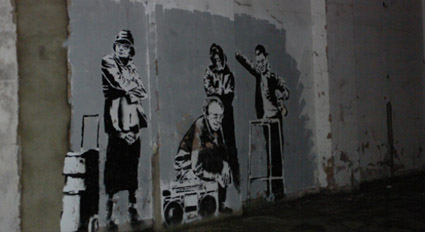
The Artiness of Naughtiness Radio Show

The Artiness of Naughtiness
BBC Radio
April 1, 2011

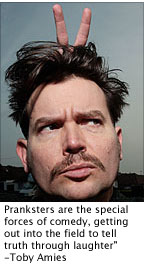
Toby Amies discovers how tricksters have turned the poking of fun into an art form.

Produced by Rob Alexander and hosted by Toby Amies, this 30:00 radio show is now available here for listening.

There are pranksters who have been determined to show us our folly all year round and most have philosophical, political and artistic reason to do so… Toby investigates this reasoning behind pranking – discovering why people will risk consequences as serious as prison to make a point or get a laugh. Sometime the motivation behind a prank is not always only a good laugh at someone else”s expense. It can be a very serious business.

Culture Jamming, Sureà±os-style

Culture Jamming, Sureà±os-style
by Michael Fallon
Utne Reader
April 1, 2011

Sometimes great cultural breakthroughs are watershed events, celebrated far and wide. When evolutionary forces conspired to mesh Appalachian hill music, Mississippi River Delta blues, and big-city boogie woogie and create a wholly new cultural entity in Elvis Presley, the country duly rejoiced. Other cultural milestones, however, arrive not at all with a bang. They percolate underground for forty years or more, roiling through several generations of evolution, adoption, innovation, and cultural adaptation, until they find a more gradual, quieter, and less publicized acceptance by the mainstream. Continue reading “Culture Jamming, Sureà±os-style”

Fool School: The Art of the Perfect Prank

Update, April 3, 2011: You can now listen to this 30:00 radio show here.


The Artiness of Naughtiness, hosted by Toby Amies, aired on BBC Radio 4 on Friday, April 1, 2011. Until April 7, 2011, you can listen to it here.


The art of the perfect prank
by Toby Amies
BBC News Magazine
30 March 2011

As April Fools jokers hatch their plans, what’s the secret to a perfect prank, asks broadcaster Toby Amies. And how far do the very best tricksters go in preparing their practical jokes?

This article is not a hoax. I promise you. It’s a serious work about the practical joke.

How far would you go to pull off a prank? The dole queue? In 1987, a young British broadcaster called Chris Morris let off helium into the BBC Bristol studio, causing the newsreader’s stories to reach a higher and higher pitch. Chris lost his job. And started his career in satire.

Would you risk prison? Pranks are often protests, against unfairness or authority or reality. And protest is increasingly risky in the 21st Century.

As the film director Billy Wilder said: “If you are going to tell people the truth, be funny or they will kill you.”

Whether personal or public, the prank has a point to make, but if you’re planning on tricking someone, it’s best to ensure everyone gets the joke. Continue reading “Fool School: The Art of the Perfect Prank”

How to Sneak an Art Exhibit Inside a Museum

From Deceptology


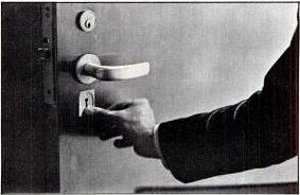
How to sneak an art exhibit inside a museum

This sneaky art prank relied on the optical illusion of
trompe l’oell photographs that were not seen as art.
(Such as a keyhole that was not a keyhole.)

Here”s how artist Harvey Stromberg deceived the Museum of Modern Art, as written in New York Magazine in June 1971:

“With the help of a friend, but with no assistance from the museum, Harvey Stromberg put on his exhibition himself. A New York artist, he describes his work as “photo-sculpture.” To prepare the exhibition, he spent some weeks in the museum, disguised as a student with a notebook under his arm, peering nearsightedly at pictures while at the same time measuring and photographing museum equipment: light switches, locks, air vents, buzzers, segments of the floor and bricks in the garden wall. These photographs he printed actual size, covered the backs with adhesive, and one day he sauntered through the museum adding 300 trompe l’oell photographs (“photosculpture”) of museum equipment to its walls and floors. (The floor pieces were a mistake: “I didn”t realize that when they buffed the floors they would buff them right off.” says Stromberg.)”

Read more here.