Catching Up With Serial Fabulist Stephen Glass

Hanna Rosin attempts to square up with her former bestie, one of American journalism’s most notorious bullshitters.

Bonus: Longform.org has a confounding collection of essays on frauds in journalism.


“Hello, My Name Is Stephen Glass, and I”m Sorry”
By Hanna Rosin
The New Republic
November 10, 2014

He nearly destroyed this magazine. Sixteen years later, his former best friend finally confronts him.

shattered-glass2

The last time I talked to Stephen Glass, he was pleading with me on the phone to protect him from Charles Lane. Chuck, as we called him, was the editor of The New Republic and Steve was my colleague and very good friend, maybe something like a little brother, though we are only two years apart in age. Steve had a way of inspiring loyalty, not jealousy, in his fellow young writers, which was remarkable given how spectacularly successful he”d been in such a short time. While the rest of us were still scratching our way out of the intern pit, he was becoming a franchise, turning out bizarre and amazing stories week after week for The New Republic, Harper”s, and Rolling Stone””each one a home run.

I didn”t know when he called me that he”d made up nearly all of the bizarre and amazing stories, that he was the perpetrator of probably the most elaborate fraud in journalistic history, that he would soon become famous on a whole new scale. I didn”t even know he had a dark side. It was the spring of 1998 and he was still just my hapless friend Steve, who padded into my office ten times a day in white socks and was more interested in alphabetizing beer than drinking it. When he called, I was in New York and I said I would come back to D.C. right away. I probably said something about Chuck like: “Fuck him. He can”t fire you. He can”t possibly think you would do that.”

I was wrong, and Chuck, ever-resistant to Steve”s charms, was as right as he”d been in his life. Continue reading “Catching Up With Serial Fabulist Stephen Glass”


4Chan v. Tumblr: Young Idealists at War

Over the last two decades, kids in the U.S. have grown up never not having had the internet. Plumbing the culture they’re maturing in and exploring the places they hone their ideas and social skills can lead to some interesting clues about the future. This is the second in a series of reports on contemporary American pranksters from Emerson Dameron, a writer, storyteller, and humorist searching for signs of life in a world plastered with ads.


4Chan v. Tumblr: Young Idealists at War
by Emerson Dameron
September 6, 2014

This summer, some of the most extreme personae on the internet celebrated their constitutional freedom of association by going to war.

Various self-contained hives of the internet give its users thousands of targeted factions to join. Over time, these sub-communities foster their own in-jokes, jargon, and culture that defies penetration by outsiders. They can be maddeningly complex. Asking their denizens the most basic of questions pegs one as impossibly square, an easy mark for mockery that strengthens the group.

These subcultures sometimes compete with each other. It can look silly from the outside, but the stakes can be quite high for those involved.

Tumblr

In the last few years, the blogging platform Tumblr, with its emphasis on sharing and community rather than high-effort original content, has become a hub for young outsiders looking for very specific places to belong. It may be eroding Facebook’s dominance among teenagers and college students, quite a few of whom seem to be in the early stages of embracing feminist theory, questioning their sexuality, and performing fraught public experiments with personal identity, gender, and politics. Because they feel so ostracized in “real life,” these Tumblr users can be intensely protective of each other and hostile toward anyone who may be antagonizing them in their safe spaces. Continue reading “4Chan v. Tumblr: Young Idealists at War”

“Liked” to the Max

What can happen if you open your floodgates (and those of your friends) to Facebook’s marketing machine?


I Liked Everything I Saw on Facebook for Two Days.
Here”s What It Did to Me

by Mat Honan
Wired
August 11, 2014

thumbs-up-425

…I like everything. Or at least I did, for 48 hours. Literally everything Facebook sent my way, I liked””even if I hated it. I decided to embark on a campaign of conscious liking, to see how it would affect what Facebook showed me. I know this sounds like a stunt (and it was) but it was also genuinely just an open-ended experiment. I wasn”t sure how long I”d keep it up (48 hours was all I could stand) or what I”d learn (possibly nothing.)

Read the whole article here.


Art of the Hoax – Joey Skaggs on PRI

Jester_waitscmMarch 30, 2014: Pranks and Hoaxes, produced by Wisconsin Public Radio and distributed by Public Radio International, presents an interview with Joey Skaggs called Art of the Hoax – Joey Skaggs.

Listen here

A New Definition of News?

UPDATE: It’s only fair to update stories when they’ve been debunked. Check out Michelle Goldberg’s explanation in The Nation about why Linda Tirado, lead character in one of the recent viral stories tagged as a hoax in the below article from the New York Times and also this one from CNN, is not a hoax.


Last week it was CNN, now it’s the New York Times weighing in on viral content as news. The new description of news is not “is it true?” but “is it interesting?” Submitted by Peter M. and Joe King.


If a Story Is Viral, Truth May Be Taking a Beating
by Ravi Somaiya and Leslie Kaufman
New York Times
December 9, 2013

viraltweet-200Truth has never been an essential ingredient of viral content on the Internet. But in the stepped-up competition for readers, digital news sites are increasingly blurring the line between fact and fiction, and saying that it is all part of doing business in the rough-and-tumble world of online journalism.
Enlarge This Image

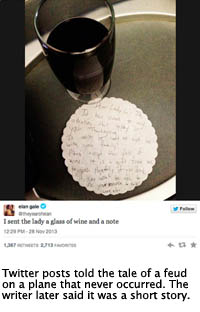
Twitter posts told the tale of a feud on a plane that never occurred. The writer later said it was a short story.
Enlarge This Image

Twitter posts about a feud on a plane that never happened.

John Cook, Gawker”s editor, said it was impossible to vet all its articles.
Several recent stories rocketing around the web, picking up millions of views, turned out to be fake or embellished: a Twitter tale of a Thanksgiving feud on a plane, later described by the writer as a short story; a child”s letter to Santa that detailed an Amazon.com link in crayon, but was actually written by a grown-up comedian in 2011; and an essay on poverty that prompted $60,000 in donations until it was revealed by its author to be impressionistic rather than strictly factual.

Their creators describe them essentially as online performance art, never intended to be taken as fact. But to the media outlets that published them, they represented the lightning-in-a-bottle brew of emotion and entertainment that attracts readers and brings in lucrative advertising dollars.

Continue reading “A New Definition of News?”