Sometimes Art Imitates Art

Flattering fakes.


The Illicit Allure of Art Forgery, by Olivia McEwan, Hyperallergic, September 11, 2023

An anarchic desire to undermine the art world’s institutions lends art forgers a roguish, rebellious identity that is both compelling and unsavory.

LONDON — A certain romanticism surrounds art forgery. Unlike other material goods, such as watches, handbags, or even coins, artworks are unique objects, the value of which is determined by quantitative and qualitative factors. For this reason their trade within art markets relies to a great extent on good faith. The success of commercial galleries and dealers depends on integrity — that what they are selling is what they say. Deliberate deceit, and on a significant scale, is cause for scandal and a career’s end, as in the high-profile case of Knoedler, an art dealership established in 1846 but closed in 2011 following a flurry of lawsuits.

It is arguably especially embarrassing when national museums, staffed by art historical experts who are (on paper at least) driven by the interests of the public as opposed to financial gain, become tangled up in a contested artwork. The Louvre and the Musée Jacquemart-André in Paris, the National Gallery of London, the Metropolitan Museum of Art in New York, and the Kunsthistorisches Museum in Vienna have all at some point endorsed the authenticity of works sold by the alleged forger Giuliano Ruffini, charged with gang fraud and money laundering in December 2022…

…the Courtauld Gallery presents an unconventional exhibition, Art and Artifice: Fakes from the Collection, which comprises nothing but forgeries it has acquired during its history. Read the whole article here

It’s a Bird. It’s a Plane. It’s a… What?

It’s not Casper the Friendly Ghost!


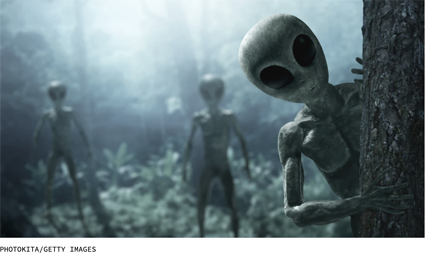
‘Flying Aliens’ Harassing Village in Peru Are Actually Illegal Miners With Jetpacks, Cops Say, by Nathaniel Janowitz, Vice, August 14, 2023

Authorities announced their theory after visiting the isolated Indigenous community where the attacks took place.

The mysterious attacks began on July 11.

“Strange beings,” locals said, visiting an isolated Indigenous community in rural Peru at night, harassing its inhabitants and attempting to kidnap a 15-year-old girl.

“These gentlemen are aliens. They seem armored like the green goblin from Spider Man. I have shot one twice and it didn’t fall. Instead, it elevated and disappeared,” Jairo Reátegui Ávila, a local leader of the Indigenous Ikitu group living in the northwestern Maynas province, told Peruvian radio station RPP Noticias on August 1. “We’re frightened by what is happening in the community.”

“Their color is silver, their shoes are round in shape and with those, they rise up. They float one meter high and have a red light on their heel,” said Ávila. “Their heads are long, their mask is long, and their eyes are sort of yellowish.” Read the rest of the story here.

Confessions of a Rock and Roll Poser

Last autumn, Jered “Threatin” Eames staged the most alienating, least explicable rock tour stunt since the Sex Pistols hit the deep south. He recently broke his silence.


“The Great Heavy Metal Hoax”
by David Kushner
Rolling Stone
December 14, 2018

In November, managers of rock clubs across the United Kingdom began sharing the same weird tale. A pop-metal performer, Threatin, had rented their clubs for his 10-city European tour. Club owners had never heard of the act when a booking agent approached them promising packed houses. Threatin had fervent followers, effusive likes, rows of adoring comments under his YouTube concert videos, which showed him windmilling before a sea of fans. Websites for the record label, managers and a public-relations company who represented Threatin added to his legitimacy. Threatin’s Facebook page teemed with hundreds of fans who had RSVP’d for his European jaunt, which was supporting his album, Breaking the World.

But despite all the hype, almost no one came to the shows. It was just Threatin and his three-piece band onstage, and his wife, Kelsey, filming him from the empty floor. And yet Threatin didn’t seem to care — he just ripped through a set as if there was a full house. When confronted by confused club owners, Threatin just shrugged, blaming the lack of audience on bad promotion. “It was clear that something weird was happening,” says Jonathan “Minty” Minto, who was bartending the night Threatin played at the Exchange, a Bristol club, “but we didn’t realize how weird.” Intrigued, Minto and his friends started poking around Threatin’s Facebook page, only to find that most of the fans lived in Brazil. “The more we clicked,” says Minto, “the more apparent it became that every single attendee was bogus.”

It all turned out to be fake: The websites, the record label, the PR company, the management company, all traced back to the same GoDaddy account. The throngs of fans in Threatin’s concert videos were stock footage. The promised RSVPs never appeared. When word spread of Threatin’s apparent deception, club owners were perplexed: Why would someone go to such lengths just to play to empty rooms? Read more.

Reality: Now Faker Than Ever

In a brilliant and dizzying end-of-year rant, Max Read takes stock of how much of our digital world is constructed from weapons-grade fraud, deception, nonsense, hokum, and miscellaneous bullshit.


“How Much of the Internet is Fake? Turns Out, a Lot of It, Actually”
by Max Read
New York Intelligencer
December 26, 2018

How much of the internet is fake? Studies generally suggest that, year after year, less than 60 percent of web traffic is human; some years, according to some researchers, a healthy majority of it is bot. For a period of time in 2013, the Times reported this year, a full half of YouTube traffic was “bots masquerading as people,” a portion so high that employees feared an inflection point after which YouTube’s systems for detecting fraudulent traffic would begin to regard bot traffic as real and human traffic as fake. They called this hypothetical event “the Inversion.”

In the future, when I look back from the high-tech gamer jail in which President PewDiePie will have imprisoned me, I will remember 2018 as the year the internet passed the Inversion, not in some strict numerical sense, since bots already outnumber humans online more years than not, but in the perceptual sense. The internet has always played host in its dark corners to schools of catfish and embassies of Nigerian princes, but that darkness now pervades its every aspect: Everything that once seemed definitively and unquestionably real now seems slightly fake; everything that once seemed slightly fake now has the power and presence of the real. The “fakeness” of the post-Inversion internet is less a calculable falsehood and more a particular quality of experience — the uncanny sense that what you encounter online is not “real” but is also undeniably not “fake,” and indeed may be both at once, or in succession, as you turn it over in your head. Read more.

Taxidermied Anteater Fools Photography Contest Judges

Well, it was alive at some point…


Wildlife photo competition disqualifies ‘stuffed anteater’ image
by Jonathan Amos
BBC Science Correspondent
27 April 2018

A winning entry in the Wildlife Photographer of the Year competition has been disqualified for featuring a taxidermy specimen.

The image, known as The Night Raider, shows an anteater moving towards a termite mound in a Brazilian reserve.

Mr Cabral said flashes and a long exposure were needed to capture the scene

London’s Natural History Museum, which runs the competition, says the use of stuffed animals breaches its rules.

The photographer, Marcio Cabral, denies he faked the scene and claims there is a witness who was with him on the day.

Other photographers and tourists were in the park at the same time and therefore “it would be very unlikely anyone wouldn’t see a stuffed animal being transported and placed carefully in this position”, he told BBC News.

But Roz Kidman Cox, the chair of judges for Wildlife Photographer of the Year (WPY), was stern in her criticism.

“This disqualification should remind entrants that any transgression of the rules and spirit of the competition will eventually be found out,” she said.

The taxidermy specimen is held at a visitors’ centre at an entrance to the park

The Night Raider picture won the Animals In Their Environment category in the 2017 WPY awards. It was taken in Emas National Park. Continue reading “Taxidermied Anteater Fools Photography Contest Judges”