“Away in a manger, no crib for a bed, the little Lord Jesus laid down His sweet head…”
and then…
and then…
and then…
Along came Skaggs with his 1968 anti-war art protest, “Vietnamese Christmas Nativity Burning.”
…Exploring the role of the prankster as artist, activist and social observer and the significance of the prank in society.
“Away in a manger, no crib for a bed, the little Lord Jesus laid down His sweet head…”
and then…
and then…
and then…
Along came Skaggs with his 1968 anti-war art protest, “Vietnamese Christmas Nativity Burning.”
Fart art. Words don’t do it justice. The video in the article explains it…
“Wake Up, Beeple!,” by Valentina Di Liscia, Hyperallergic, December 4, 2025.
Crypto-backed artworks at Art Basel Miami Beach advance the wealth mechanisms they claim to subvert and make you, the viewer, a participant in the ploy.
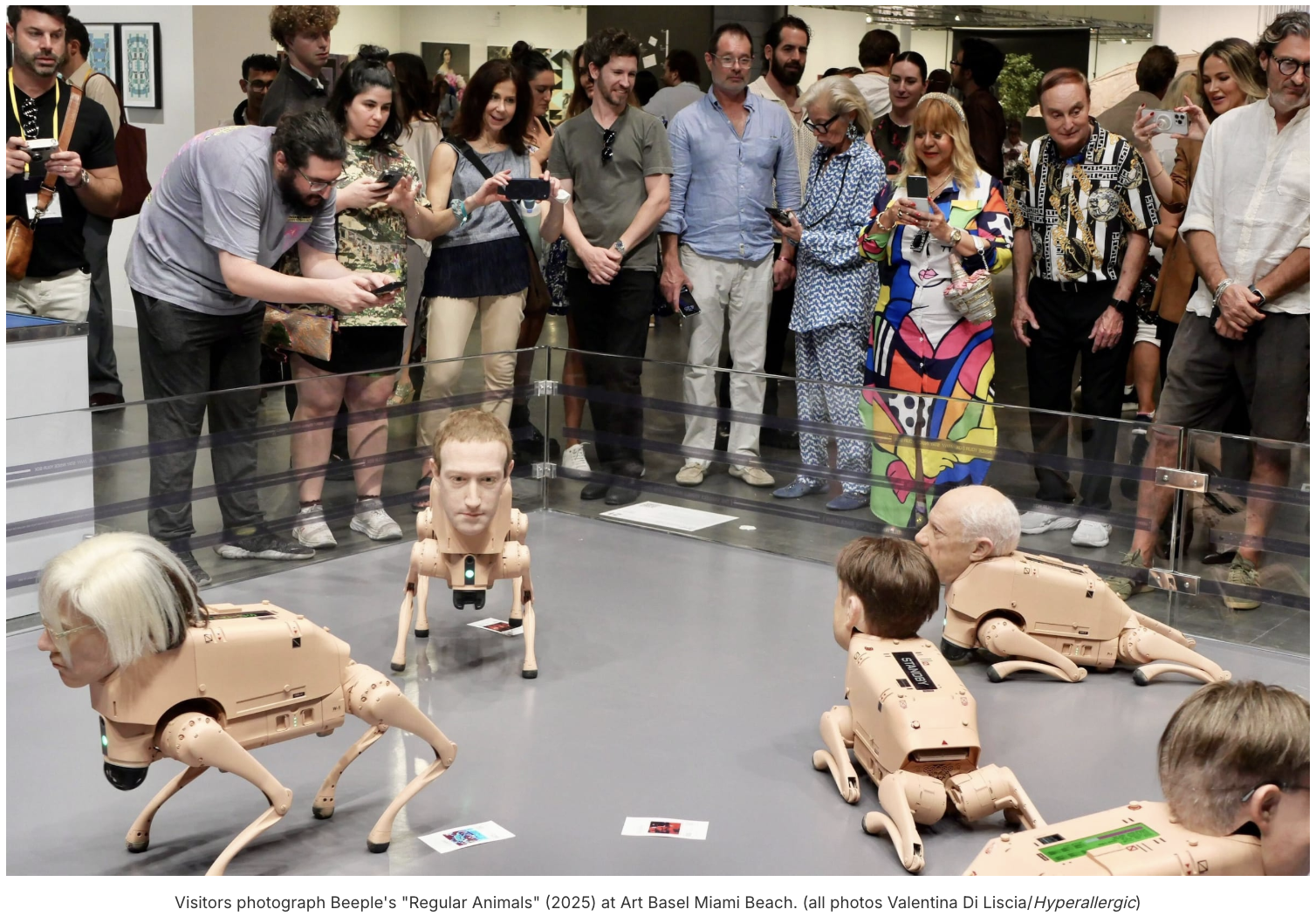
A monstrous specimen of art as social commentary takes form when the work in question replicates the mechanisms the artist boasts about subverting, and at Art Basel Miami Beach, in a new section titled Zero 10 backed by the crypto marketplace OpenSea, Jack Butcher’s “Self Checkout” (2025) is its most shameless manifestation.
The installation consists of a checkout counter powered by Stripe terminals that beckon visitors to tap their cards and pay any amount, receiving a printed receipt whose length is proportional to their payment and comes with an “NFT companion.” A ticker above the counter tracks the lucre from an initial value of -$75,000, Butcher’s stated investment in the piece. Read the whole article here.
It’s about time…
“Learn ‘How to Be a Guerrilla Girl’ at The Getty,” by Beverly Press, November 26, 2025.
Coinciding with the Guerrilla Girls’ 40th anniversary, “How to Be a Guerrilla Girl,” on view at the Getty through April 12, 2026, offers a rare, behind-the-scenes look into the inner workings of the iconic feminist art collective.
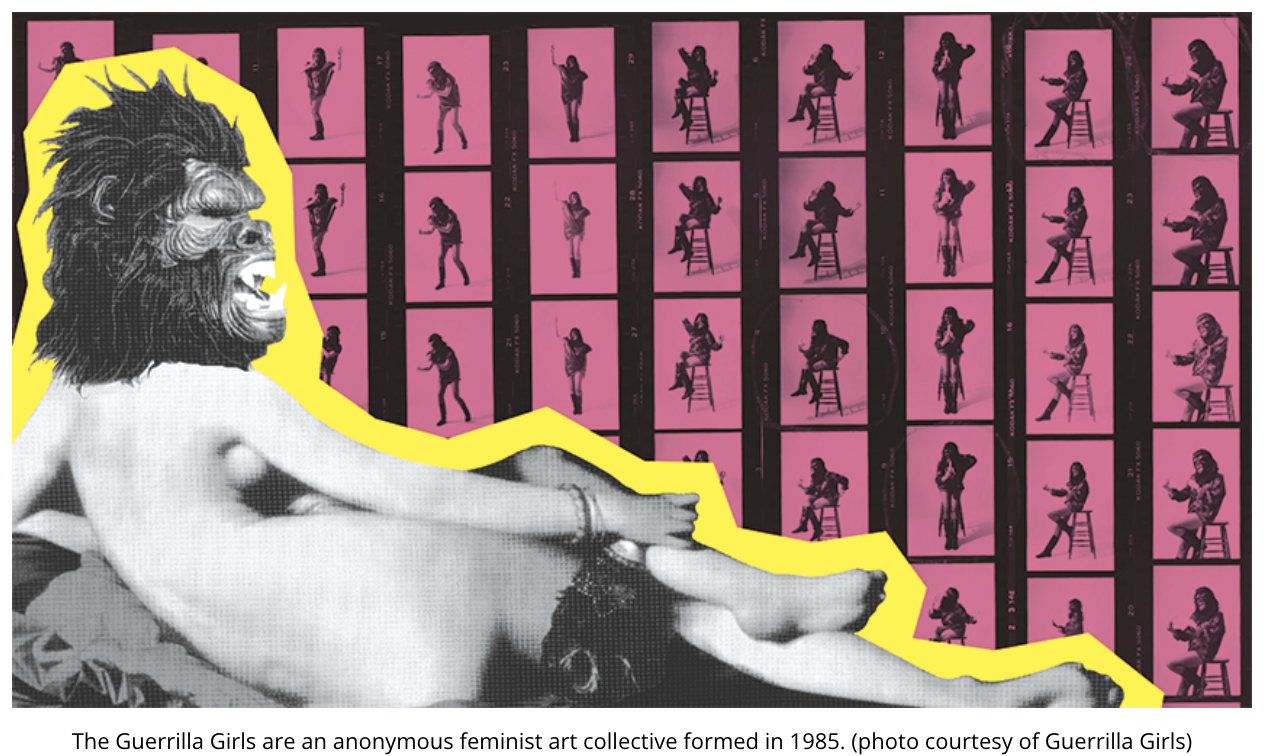
Drawing from the Getty Research Institute’s remarkable Guerrilla Girls archive, the exhibition highlights the strategies – anonymity, data gathering, protest actions, culture jamming and grassroots distribution – that have defined the group’s groundbreaking practice since the mid-1980s.
The Guerrilla Girls have created a newly-commissioned work for the exhibition that explores the Getty’s own collection of European painting and sculpture. Using comic strip style speech bubbles, they reimagine the voices of women represented in these artworks through a twenty-first century lens. The commission exposes deeply rooted biases in the representation of women in Guerilla Girls characteristic witty style. Read the whole article here.
From the Vault: Maqdananda
“Why deal with the legal system without knowing the outcome beforehand?”-Maqdananda
Legal council from the other side. From courtrooms to crystal balls, Maqdananda brings legal advice to another dimension.
Joey Skaggs as Maqdananda, Psychic Attorney, in a :30 CNN TV commercial (1994).
Imitation is the most insincere form of flattery…
In the past few months, at least three of Joey Skaggs’ classic performance works have mysteriously resurfaced—-minus the credit, the context, and, of course, the artist himself. From Elon Musk promising to replace judges and juries with his Grok AI, to a TikTok “influencer” teaching New Yorkers how to walk politely, to a national law firm resurrecting The Fat Squad to sell legal services—Skaggs’ art seems to have been reborn through the copy machine of culture.
If plagiarism is the sincerest form of flattery, Joey must be the most loved man in America.
But underneath the irony lies a serious question: as artificial intelligence devours the world’s creative work—scraping, remixing, and regurgitating ideas at scale—what content ownership will artists be left with? Who gets to claim the joke when everyone’s telling it?
Skaggs has spent his life exposing how easily truth can be twisted, and how the media loves a good story—whether it’s real or not. Now, his work is living proof that in the age of AI and viral mimicry, even satire can’t escape being swallowed whole.
So, here’s to keeping art human, authorship honest, and mischief original.
IN THE COURT OF PUBLIC OPINION
JOEY SKAGGS,
Plaintiff,
v.
MORGAN & MORGAN,
Defendant.
COMPLAINT FOR MISAPPROPRIATION OF UNAUTHORIZED SATIRE AND CULTURAL DILUTION
New York, NY — Artist, satirist, and cultural saboteur Joey Skaggs today filed a lawsuit in the Court of Public Opinion against America’s largest personal injury law firm Morgan & Morgan for shamelessly swiping his legendary Fat Squad media hoax and stuffing it into their latest commercial.
For the record, The Fat Squad (est. 1986) was a groundbreaking internationally successful performance art hoax in which comandos were contracted to guard dieters around the clock — tackling them away from Twinkies, escorting them past buffets, and yelling “Drop that donut!” before it hit their lips. It is memorialized in both Andrea Marini’s “Art of the Prank” documentary and Joey Skaggs’ Oral History film series.
Joey Skaggs: The Fat Squad tease:
Morgan & Morgan’s new ad? Blatantly similar — but with all the calories of satire burned off.
THE FACTS
THE CHARGES
DAMAGES DEMANDED
Plaintiff demands compensation in the form of:
PLAINTIFF’S STATEMENT
“When I created The Fat Squad, it was to satirize America’s obsession with weight control, and consumer excess. To see a law firm steal it and call it comedy? That’s not just plagiarism. That’s malpractice. Artistic malpractice.” —Joey Skaggs, Satirist-Still-At-Large
CONCLUSION
The Fat Squad doesn’t forgive. The Fat Squad doesn’t forget. And if Morgan & Morgan thinks they can out-satire Joey Skaggs… well, let’s just say the Court of Public Opinion is always in session, and the jury is already laughing.